

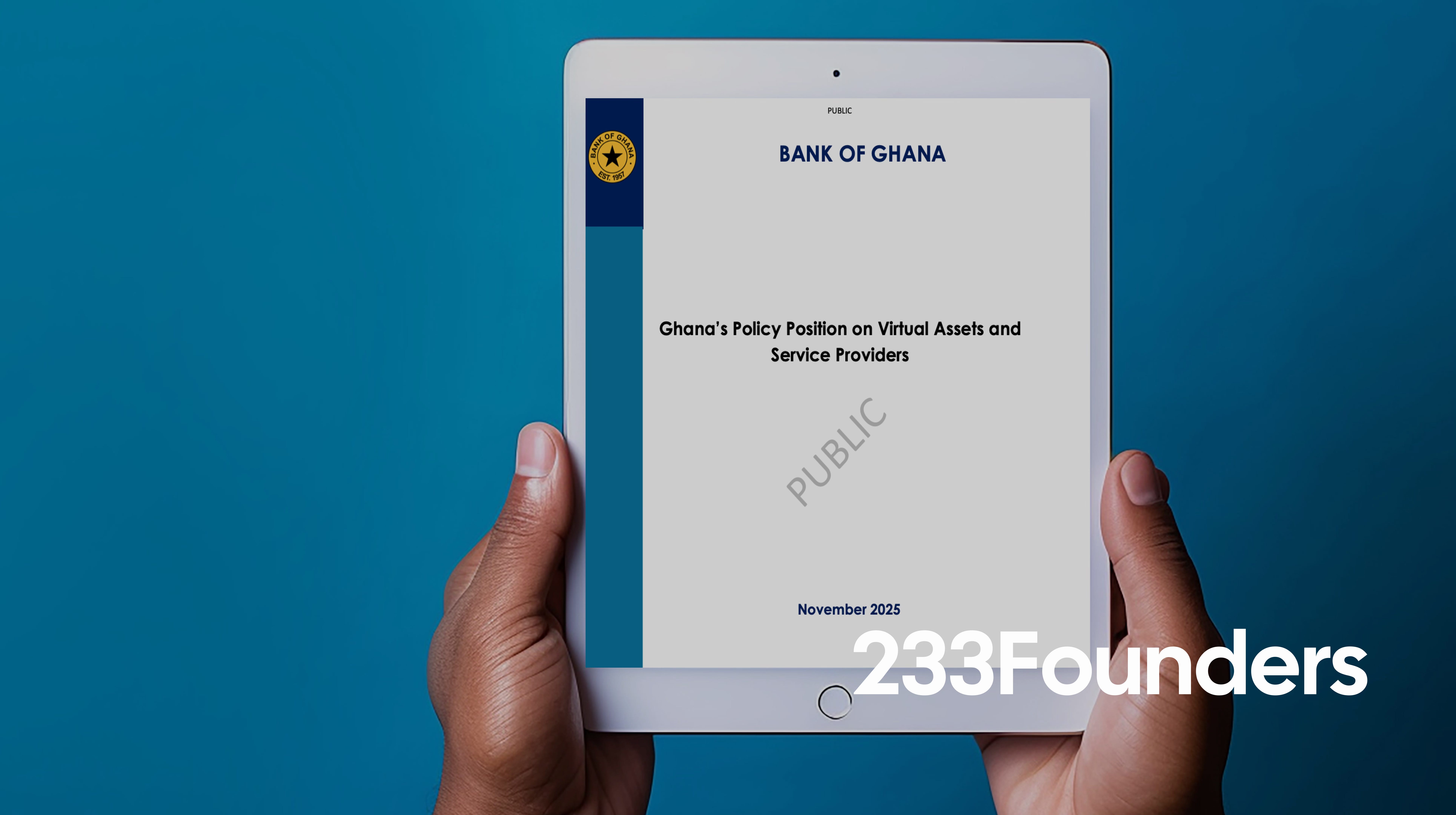
Ghana’s financial regulators — the Bank of Ghana (BoG), Securities and Exchange Commission (SEC), and Financial Intelligence Centre (FIC) — have adopted a unified national stance to bring Virtual Assets (VAs) and Virtual Asset Service Providers (VASPs) under regulatory oversight. With over 3 million users and 100+ VASPsoperating in the country, the document outlines Ghana’s intention to manage opportunities and risks in the fast-growing crypto and blockchain ecosystem.
Following the 2024 AML/CFT/CPF Risk Assessment, regulators identified rising virtual asset activity across payments, trading, and custody with minimal oversight, heightening risks of money laundering, terrorist financing, and consumer harm. Ghana rejects an outright ban — seen as counterproductive — and instead pursues a risk-based regulatory framework to balance innovation, inclusion, and financial integrity.
Regulatory Principles
The policy is built on six key principles:
Regulation of VASPs: Virtual assets must fall under regulatory supervision.
Activity-based approach: Regulation depends on the function (e.g., trading, custody), not technology.
Risk-based supervision: Oversight should match the risk level of activities.
Collaborative governance: BoG, SEC, FIC, CSA, and DPC must coordinate policy and enforcement.
Dynamic monitoring: Regulators must adapt to evolving global standards (FATF, IMF, IOSCO, etc.).
Public literacy: Promote digital and financial literacy to protect consumers from fraud.
Policy Approach
Ghana’s legal framework will be:
Principle-based – flexible, high-level laws with detailed secondary directives.
Activity-based – focused on services provided (custody, payments, tokenization, etc.).
Risk-based – tailored licensing based on each use case’s potential for harm.
Key Recommendations
Mandatory licensing for all VASPs with BoG or SEC based on activity type.
Integrate regulation with the Anti-Money Laundering Act, 2020 (Act 1044) and global standards (FATF, IMF, BIS).
Enforce the FATF “Travel Rule” for transaction traceability.
Define regulatory roles:
BoG – payments, custody, and monetary implications.
SEC – trading and investment.
FIC – AML/CFT compliance.
Continuous ecosystem monitoring to detect illicit activity.
Maintain non-legal tender status for all virtual assets.
Establish a Virtual Assets Regulatory Office (VARO) for coordination, oversight, and policy incubation.
Launch the National Virtual Assets Literacy Initiative (NaVALI) to educate citizens and promote responsible use.
Conclusion
Ghana’s 2025 policy represents a turning point from caution to structured engagement with digital assets. It signals readiness to regulate innovation responsibly — aligning with global best practices while preserving financial stability, consumer protection, and regulatory integrity.
Download the full policy statement here